Digital Impressions: How Intraoral Scanning Works
No impression tray, no impression paste: how the intraoral scanner creates an exact 3D model of your teeth in minutes.


Anyone who has ever had a conventional impression will remember: a large tray full of paste, keeping still for several minutes, perhaps gagging. A digital impression with an intraoral scanner makes this unnecessary for many treatments.
An intraoral scanner is a small camera that is moved over the teeth and creates a three-dimensional model in real time. The scan usually takes only a few minutes, is very accurate and can be used directly for CAD/CAM fabrication at the practice or sent digitally to the laboratory.
Advantages for patients
- no gagging caused by impression paste
- no waiting for the material to set
- the result is visible straight away on the screen – individual areas can be rescanned
- the basis for precisely fitting ceramic restorations made with CAD/CAM
- documentation of the condition of your teeth, allowing comparison over the years
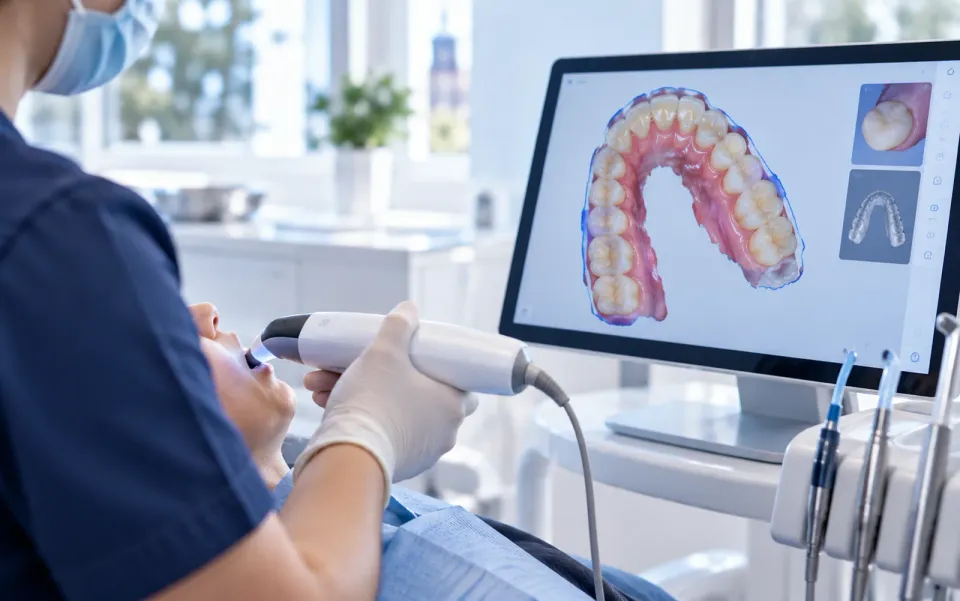

How the scan works
Procedure- DryingThe teeth are briefly dried so that the camera gets clear images.
- ScanningThe camera is moved over the chewing surfaces and the inner and outer sides.
- Recording the biteYou bite together, and a scan from the side records how your teeth meet.
- CheckOn the screen we check the preparation margins and details.
What are digital impressions suitable for?
They are ideal for inlays, partial crowns, crowns, smaller bridges, implant crowns, occlusal splints and veneers. For very extensive restorations or removable dentures, a conventional impression may still make sense.
Book your appointment at the Zahnarztpraxis St. Peter – via online booking or by phone on 0911 554181. You will find us at Hainstraße 25, 90461 Nürnberg (tram 6/10 to Scharrerstraße, patient parking via Scharrerstraße).
Frequently asked questions
Is the scan safe for my health?
Yes. The scanner works with visible light, not with X-rays.
Does the digital impression cost extra?
That depends on the restoration. We state the costs in the treatment and cost plan.
This article is a translation of our German guide and does not replace a personal examination and consultation. If you have symptoms, please see a dentist – for example at the Zahnarztpraxis St. Peter in Nuremberg.