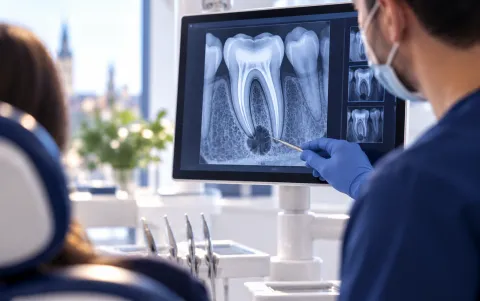
Apicoectomy: When It Is Needed and How It Works
If inflammation at the root tip persists despite root canal treatment, an apicoectomy can save the tooth.


Sometimes inflammation at the root tip does not heal despite careful root canal treatment – for example because bacteria sit in fine branches of the root tip that cannot be reached from inside the tooth. An apicoectomy (root-end resection, in German “Wurzelspitzenresektion”, WSR) can then be a way of keeping the tooth after all.
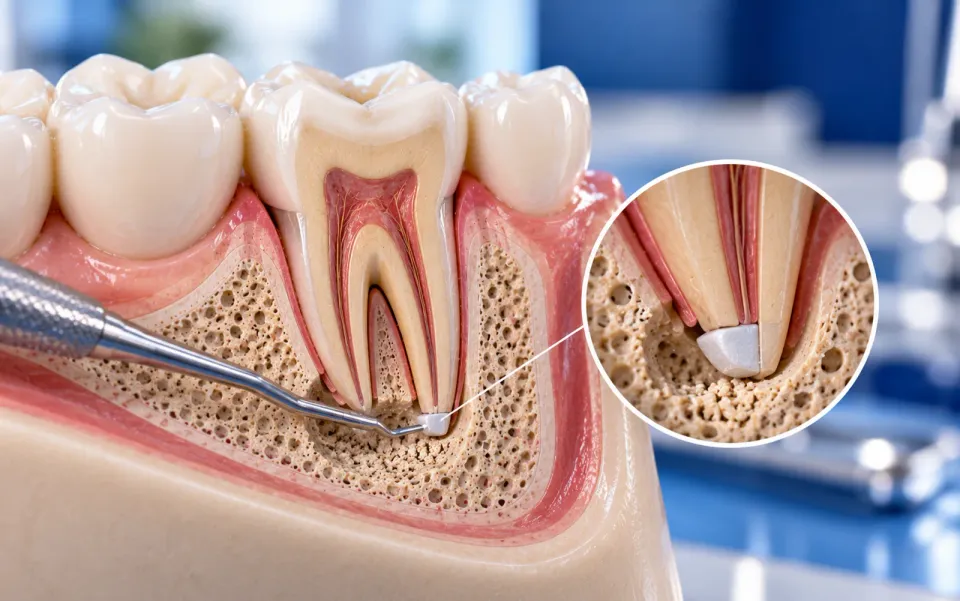
In an apicoectomy, the gum is opened under local anaesthesia, the inflamed root tip is removed together with the surrounding inflamed tissue, and the root canal is sealed tightly from below. The wound usually heals within one to two weeks; the bone needs a few months.
When does an apicoectomy make sense?
- if inflammation persists after root canal treatment and a retreatment is not possible or not promising
- if a post or crown prevents retreatment from above
- for cysts at the root tip
- if a broken instrument or calcification blocks the canal
As a general rule, we first check whether a retreatment from above is possible. An apicoectomy complements root canal treatment; it does not replace it.
Procedure
Procedure- X-ray and planningThe position of the root tip, neighbouring structures and the extent of the inflammation are assessed; if necessary with a 3D scan (CBCT).
- Anaesthesialocal, as for a filling.
- AccessA small incision in the gum; the bone over the root tip is exposed.
- ResectionThe last two to three millimetres of the root and the inflamed tissue are removed.
- Retrograde sealingThe canal is sealed tightly from the tip with a biocompatible material – particularly precisely under the operating microscope.
- StitchesThe gum is stitched; the stitches are removed after about a week.

After the procedure
Swelling and mild pain are normal in the first few days. Cooling, rest and soft food help. Please do not smoke. We check the healing of the bone with an X-ray after a few months.
Book your appointment at the Zahnarztpraxis St. Peter – via online booking or by phone on 0911 554181. You will find us at Hainstraße 25, 90461 Nürnberg (tram 6/10 to Scharrerstraße, patient parking via Scharrerstraße).
Frequently asked questions
How much does an apicoectomy cost?
That depends on the tooth and the effort involved. You receive a written cost estimate before the procedure.
How long does a tooth last after an apicoectomy?
That depends on the initial situation. If the indication is right and the tooth is well sealed, it can be kept for many years.
This article is a translation of our German guide and does not replace a personal examination and consultation. If you have symptoms, please see a dentist – for example at the Zahnarztpraxis St. Peter in Nuremberg.