Root Canal Treatment: The Procedure Step by Step
What happens during root canal treatment, how long does it take and does it hurt? The procedure in eight steps – clearly explained.


Hardly any treatment has as bad a reputation as root canal treatment – and hardly any is as important for saving a tooth. The good news: with modern anaesthesia, rotary instruments and magnification, it is usually very bearable today. If you know what to expect, you can go into your appointment more relaxed.
In root canal treatment the tooth is numbed and isolated with a rubber dam. The dentist then opens the tooth, removes the inflamed tissue from the canals, widens and disinfects them and seals them tightly with gutta-percha. Finally, the tooth is closed so that no bacteria can get in and is usually protected with a crown. One to three appointments are often needed.
Why is root canal treatment needed at all?
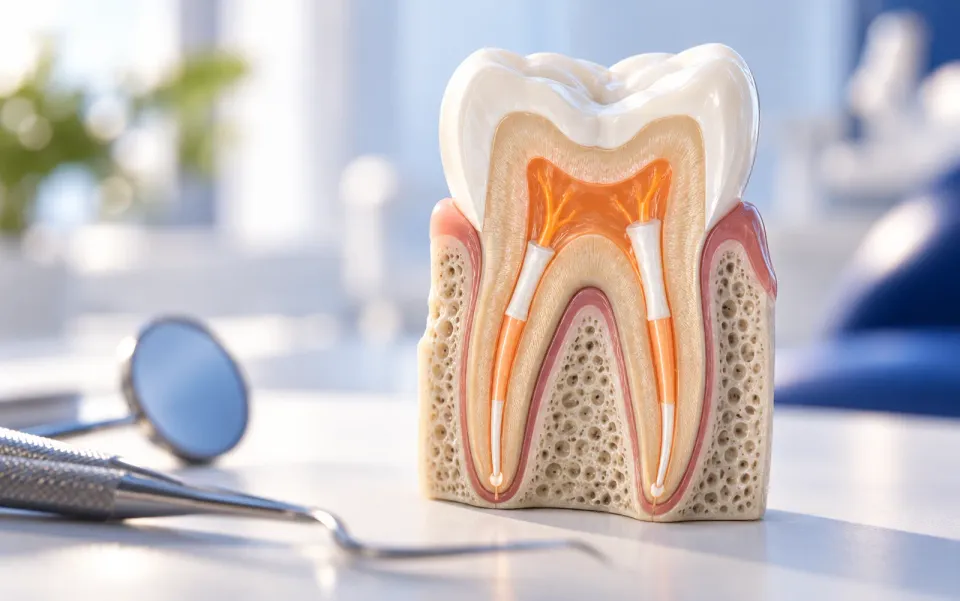
Inside the tooth lies the pulp, a tissue made up of nerves and blood vessels. If bacteria reach it – for example through deep decay or a crack – it becomes inflamed. Because the tooth is surrounded by hard tissue, the pulp cannot swell; the pressure causes the typical, often throbbing pain. If the pulp dies, bacteria can spread into the jawbone. Root canal treatment removes the cause and preserves the tooth.
The procedure in eight steps
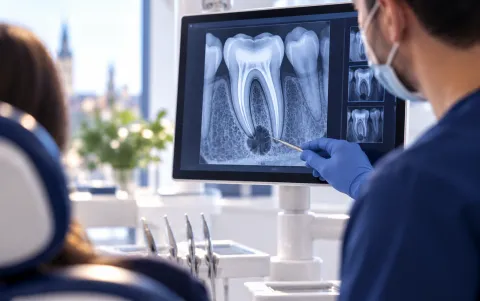
Procedure- DiagnosisCold test, percussion test, X-ray: is the nerve inflamed or already dead? How many canals does the tooth have, and how curved are they?
- AnaesthesiaA local anaesthetic switches off the sensation of pain. In severely inflamed teeth it sometimes takes effect more slowly; we then give a top-up injection.
- Rubber damA thin rubber sheet is stretched over the tooth. It keeps saliva and bacteria away and protects you from rinsing solutions and small instruments.
- AccessThe tooth is opened from the top and the canal entrances are located – ideally under the dental operating microscope.
- ShapingFine, flexible nickel-titanium files are used to clean and widen the canals. Electronic length measurement shows where the root tip is.
- DisinfectionRinsing solutions dissolve tissue remnants and kill bacteria – even in side canals that no instrument can reach.
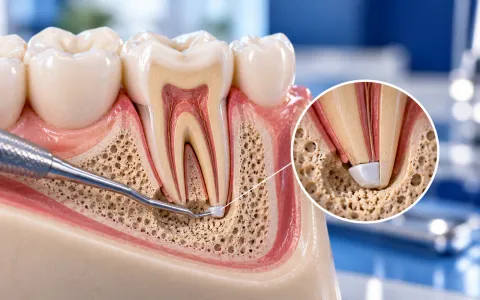
- Root fillingThe canals are filled tightly to the tip with gutta-percha, a rubber-like natural material, and a sealer. If the inflammation is severe, a medicated dressing is placed for a few days first.
- Sealing and crownA tight core build-up prevents new bacteria from getting in. Back teeth are then usually protected with a partial or full crown.

How long does root canal treatment take?
Depending on the tooth, a single session takes about 60 to 120 minutes. Front teeth usually have one canal, back teeth three or four – sometimes more. If the inflammation is recent and easy to control, the treatment can be completed in one appointment. With pus-forming inflammation, a temporary medicated dressing makes sense, and one or two further appointments follow.
Does root canal treatment hurt?
Thanks to the anaesthetic, most patients feel only pressure and vibration during the treatment. In the days afterwards the tooth may be sensitive when biting – the tissue at the root tip needs to settle down. More on this in the article Pain after root canal treatment.
What are the chances of success?
The prognosis depends on how far the inflammation has progressed, whether all canals could be found and cleaned, how tight the filling is and whether the tooth is properly restored afterwards. Careful treatment with a rubber dam, magnification and a well-sealed crown clearly improves the chances. Important: there are no guarantees in medicine – but trying to keep your own tooth is worthwhile in most cases.
After root canal treatment the tooth is “dead” and can no longer warn you. So please make sure you come to your check-ups – renewed inflammation often only shows up on an X-ray.
Has root canal treatment been recommended to you, or do you have toothache? Book your appointment at the Zahnarztpraxis St. Peter – via online booking or by phone on 0911 554181. You will find us at Hainstraße 25, 90461 Nürnberg (tram 6/10 to Scharrerstraße, patient parking via Scharrerstraße).
Frequently asked questions
Can I go to work after root canal treatment?
Usually yes. Wait until the anaesthetic has worn off before eating, and chew on the other side for the first few days.
Why does the tooth need a crown afterwards?
A root-treated back tooth has often lost a lot of tooth structure and becomes more brittle. A crown or partial crown protects it from fracturing and seals it against bacteria.
What is a rubber dam?
A thin, stretched rubber sheet that isolates the tooth from the rest of the mouth. It is considered the standard for hygienic root canal treatment.
This article is a translation of our German guide and does not replace a personal examination and consultation. If you have symptoms, please see a dentist – for example at the Zahnarztpraxis St. Peter in Nuremberg.