Dentist Nuremberg St. Peter
Dental Implants in Nuremberg
Fixed teeth that feel like your own: planning, implant placement and crown all in one practice – by a Master of Science in implantology.


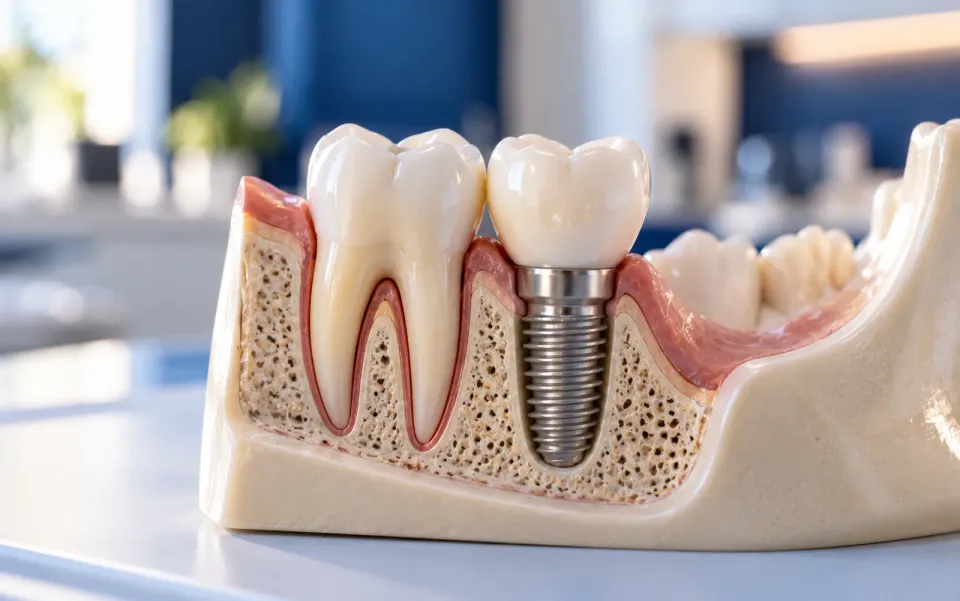
A dental implant replaces the lost tooth root. It is anchored in the jawbone and then carries a crown, a bridge or a denture. Because implants are firmly fixed, they feel like your own teeth when chewing and speaking – and the neighbouring teeth do not have to be ground down. Dentist Hassan Al-Johmani holds a Master of Science in Oral Implantology and Periodontology (DGI/Steinbeis University Berlin) and accompanies you from planning to the finished crown.
A dental implant is an artificial tooth root, usually made of titanium, that heals into the jawbone and then carries a crown, bridge or denture. It requires sufficient bone and healthy gums. If bone is missing, it can be built up beforehand or at the same time.
When is an implant an option?
- A single gap: an implant with a crown closes the gap without grinding down healthy neighbouring teeth for a bridge.
- Several missing teeth: implants can carry fixed bridges – even where there is no abutment tooth left at the end of the row.
- No teeth left in the jaw: just a few implants can give a denture a secure hold. No wobbling, no denture adhesive.
- After a dental accident or when a tooth cannot be saved despite root canal treatment.
A thorough preliminary examination is important. Smoking, poorly controlled diabetes, untreated gum disease or certain medications can impair healing. We discuss this openly before any planning.

How implant treatment works
Procedure- Consultation and findingsWe examine teeth, gums and bone and discuss your wishes and possible alternatives, such as a bridge.
- Three-dimensional planningUsing X-rays and, if necessary, a three-dimensional scan (CBCT), we plan the position, length and diameter of the implant.
- Treatment and cost planYou receive a transparent breakdown of the costs and of your health insurer’s fixed subsidy.
- Implant placementUnder local anaesthesia we place the implant in the jawbone. For a single implant the procedure usually takes less than an hour.
- HealingOver the following months the implant fuses firmly with the bone. During this time you wear a temporary restoration if needed.
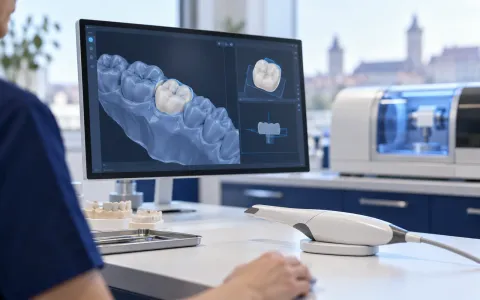
- Digital impression and crownWe scan the situation digitally and fit the precisely made crown.
- Care and follow-upRegular check-ups and professional teeth cleaning protect against inflammation around the implant.
When bone is missing: bone grafting with your own blood
After a tooth is lost, the jawbone recedes. If it is not sufficient for an implant, it can be built up. We also use a concentrate made from your own blood (PRF), which can support wound healing. Explained in detail on our page Bone grafting in Nuremberg.
How much does a dental implant cost?
The costs depend on how many implants are placed, whether bone has to be built up and which crown or denture is fitted. German statutory health insurance usually pays nothing towards the implant itself, but contributes the finding-based fixed subsidy to the restoration – with a well-kept bonus booklet even at a higher rate. Before treatment you receive a detailed treatment and cost plan from us. Background in our guide Dental implants: costs and subsidies.
| Implant with crown | Conventional bridge | |
|---|---|---|
| Neighbouring teeth | remain untouched | are ground down |
| Jawbone | is loaded and tends to be preserved | continues to recede under the gap |
| Cleaning | like a natural tooth, with floss/brushes | cleaning under the pontic needed |
| Treatment time | several months (healing) | a few weeks |
| Insurance subsidy | fixed subsidy for the standard treatment | fixed subsidy for the standard treatment |
Would you like to know whether an implant is right for you? Book your appointment at the Zahnarztpraxis St. Peter – via online booking or by phone on 0911 554181. You will find us at Hainstraße 25, 90461 Nürnberg (tram 6/10 to Scharrerstraße, patient parking via Scharrerstraße).
Frequently asked questions
Does getting an implant hurt?
The procedure is done under local anaesthesia; during it you usually only feel pressure and vibration. Swelling and mild pain are possible in the following days; they can usually be treated well with common painkillers and cooling.
How long does a dental implant last?
With good care and regular follow-up, implants can last a very long time, often decades. The greatest risk is inflammation around the implant (peri-implantitis) – which is why oral hygiene and check-ups are so important.
Am I too old for an implant?
There is no upper age limit. What matters is your general health, the bone and the ability to care for the implant. In adolescents we wait until jaw growth is complete.
What does health insurance pay?
Patients with German statutory insurance receive the fixed subsidy intended for the standard treatment of the respective finding – regardless of whether you choose an implant. The implant itself is a private service.
Do I have to live with a gap during healing?
Usually not: there are temporary solutions for the transition period so that you feel comfortable in everyday life.