Dentist Nuremberg St. Peter
CAD/CAM Crowns & Digital Impressions
Scanning instead of impression trays: ceramic crowns, partial crowns and inlays are designed on the computer and precisely manufactured.


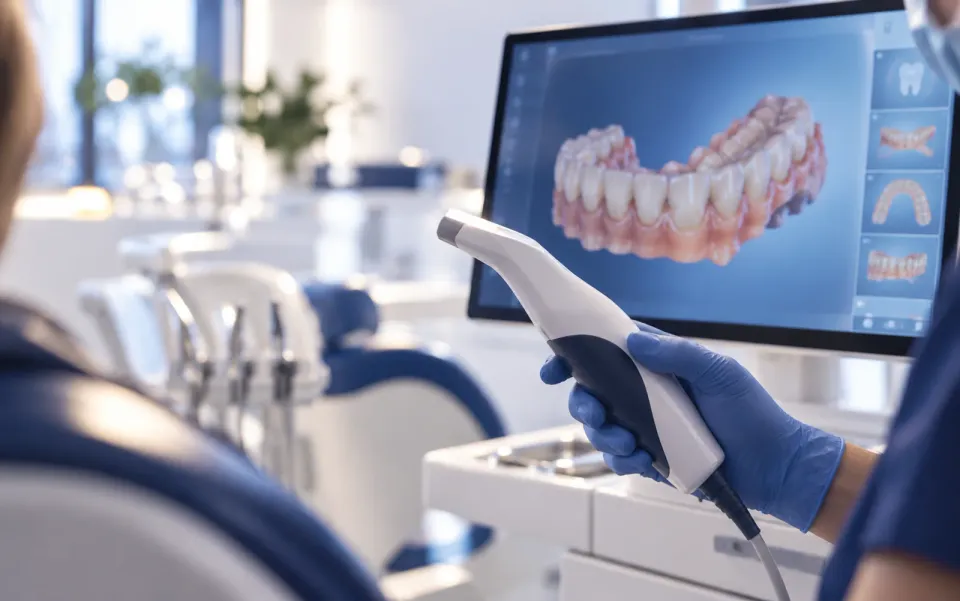
Conventional impressions with trays and impression material are largely a thing of the past at our practice. Instead, we capture the tooth with an intraoral 3D camera. On screen we design your crown, partial crown or inlay, which is then milled from a ceramic block. Dentist Al-Johmani specialised in CAD/CAM restorations with a curriculum at Ludwig Maximilian University of Munich (LMU).
CAD/CAM stands for computer-aided design (CAD) and computer-aided manufacturing (CAM). A scanner creates a 3D model of your tooth within minutes, the restoration is designed digitally and milled from a ceramic block. Advantages: no impression tray, a very precise fit and a digital record that can be retrieved at any time.
Digital impressions: more comfortable and more precise
The intraoral scanner is about the size of an electric toothbrush. It is moved over the teeth and combines thousands of individual images into an exact three-dimensional model. For you this means: no gagging from impression material, no waiting for the material to set – and a result you can see straight away on the screen.

What we make with CAD/CAM
- Inlays and onlays: ceramic fillings for larger defects in back teeth – more stable and better sealed than large composite fillings.
- Partial crowns: cover weakened cusps while preserving healthy tooth structure.
- Crowns: all-ceramic, without a dark metal margin, colour-matched to your teeth.
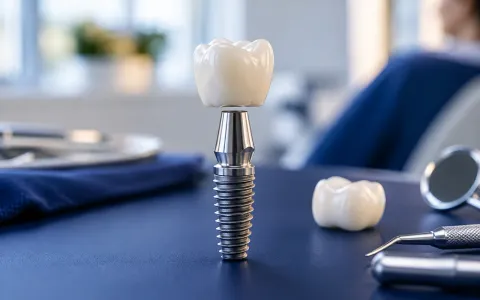
- Implant crowns: the scan captures the position of the implant digitally.
- Veneers: thin ceramic shells for the front teeth (see cosmetic dentistry).
From scan to ceramic crown
Procedure- PreparationUnder local anaesthesia we remove decay and old fillings and shape the tooth for the crown.
- ScanThe prepared tooth, the neighbouring teeth and the opposing jaw are scanned within a few minutes.
- DesignThe software suggests a chewing surface, which we adapt individually to your bite.
- Temporary crownUntil the crown is ready, a temporary crown protects the prepared tooth.
- ManufacturingThe restoration is milled from an industrially made ceramic block, fired and characterised in colour depending on the material.
- FittingAt the follow-up appointment we check fit, bite and colour and cement the crown permanently.
For bridges, very large restorations or special aesthetic requirements we work with a dental laboratory – the digital impression is simply sent electronically.
Which ceramic is right?
Depending on the tooth and the load, we use different materials: glass ceramics look particularly natural and translucent, lithium disilicate is highly fracture-resistant and suitable for crowns on back teeth, zirconia withstands even high chewing forces. We discuss which solution makes sense for you on the basis of your findings. An overview in our guide Dental crowns: materials compared.
Costs and insurance subsidy
Patients with German statutory insurance receive the fixed subsidy for crowns; ceramic restorations go beyond the standard treatment, so the difference is paid privately. For inlays, the insurer pays the amount of a comparable filling. You receive a treatment and cost plan from us in advance. More: Fixed subsidy and bonus booklet explained.
Do you need a new crown or would you like to replace an old filling? Book your appointment at the Zahnarztpraxis St. Peter – via online booking or by phone on 0911 554181. You will find us at Hainstraße 25, 90461 Nürnberg (tram 6/10 to Scharrerstraße, patient parking via Scharrerstraße).
Frequently asked questions
Is a digital impression more accurate than a conventional one?
For single-tooth restorations such as inlays, partial crowns and crowns, modern intraoral scanners achieve very high accuracy. An added benefit: we see the scan immediately and can rescan individual areas.
How many appointments do I need for a crown?
Usually two: at the first we prepare and scan the tooth, at the second we fit the finished crown. In between, the tooth is protected by a temporary crown.
Does a milled ceramic crown last as long as a lab-made crown?
The blocks are manufactured industrially under controlled conditions and are very homogeneous. With the right indication and good care, CAD/CAM restorations are durable.
Is the scan unpleasant?
No. The scanner barely touches the teeth and no impression material is needed – ideal even with a strong gag reflex.