Dentist Nuremberg St. Peter
Botulinum Toxin for TMD & Teeth Grinding
When splint, physiotherapy and relaxation are not enough: botulinum toxin can selectively relax overactive chewing muscles – as a complementary option after thorough diagnostics.


Anyone who grinds or clenches heavily knows the consequences: tense, painful chewing muscles, headaches in the morning, worn teeth. In most cases an occlusal splint, physiotherapy and a conscious approach to stress help. If that is not enough, injecting botulinum toxin A – colloquially often called “Botox” – into the chewing muscles can be a complementary option. The current German S3 guideline on bruxism now devotes a chapter of its own to this treatment.
Botulinum toxin A is injected selectively into the overactive chewing muscles, usually the large masseter muscle. It temporarily inhibits signal transmission from nerve to muscle; the muscle relaxes and pain can ease. The treatment is not a standard therapy but a complement for carefully selected patients – once diagnostics are done and conservative measures have not helped sufficiently.
When is botulinum toxin an option?
- with severe grinding or clenching (bruxism) and painful, overactive chewing muscles
- with muscle-related TMD complaints such as jaw and facial pain or tension headaches
- when occlusal splint, physiotherapy and stress management have been exhausted or have not helped sufficiently
Botulinum toxin replaces neither diagnostics nor the splint. It treats the overactivity of the muscle, not the cause of the grinding – which is why we only use it as part of an overall concept.
How does the treatment work?
At the so-called motor end plate, botulinum toxin blocks the release of the messenger substance that makes the muscle contract. The treated muscle therefore works more weakly for a few months: it can still chew, but clenches less forcefully. The effect begins after a few days, is fully developed after about two weeks and wears off again after roughly three to four months.
The process at our practice
Procedure- Functional diagnosticsConversation, clinical functional analysis, examination of muscles, joints and teeth. Only the diagnosis shows whether the complaints are muscle-related.
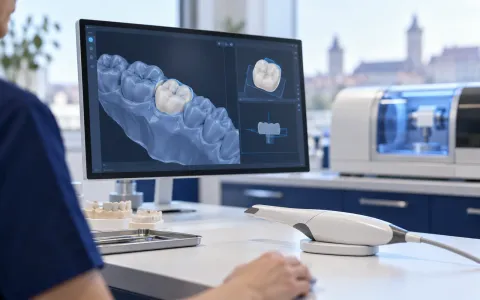
- Conservative therapy firstAs a rule we start with a 3D-printed occlusal splint, exercises, physiotherapy and stress reduction.
- Detailed consultationabout effect, limits, alternatives, possible side effects and off-label use (use outside the approved indications). You can take your time to decide.
- Injectionwith a very fine needle at precisely defined points of the chewing muscles. The appointment is short.
- Follow-upAfter about two weeks we check the effect. We only plan a repeat if it makes sense.
What do studies show?
The evidence is nuanced: systematic reviews show that botulinum toxin A can reduce pain intensity compared with placebo and measurably reduce muscle activity. Mouth opening and quality of life can also improve. In terms of jaw mobility, however, it is not superior to placebo or standard therapies, and the studies differ greatly in dosage, injection technique and follow-up. More in our guide Botox for bruxism and TMD: effect, evidence, limits.
Risks and side effects
Possible effects are temporary chewing weakness with hard food, tenderness or small bruises at the injection site, and rarely an asymmetric smile. Because the muscle works less, it can lose volume; the lower face then looks slimmer. Compared with other treatments, the risk of undesirable effects on muscle and bone tissue is considered higher – one more reason to use it only when clearly indicated. We do not treat during pregnancy and breastfeeding or with certain neuromuscular diseases.
Costs
Botulinum toxin is not approved for TMD and bruxism; it is used off-label and is a private service. We give you the costs in writing in advance.
Do you grind heavily, and the splint alone is not helping enough? Book your appointment at the Zahnarztpraxis St. Peter – via online booking or by phone on 0911 554181. You will find us at Hainstraße 25, 90461 Nürnberg (tram 6/10 to Scharrerstraße, patient parking via Scharrerstraße).
Frequently asked questions
Does Botox replace the occlusal splint?
No. The splint protects the teeth from wear, botulinum toxin relaxes the muscle. Both can complement each other; the splint usually remains part of the therapy.
How long does the effect last?
Usually about three to four months. Then the body breaks down the botulinum toxin and the muscle works as before.
Is the treatment painful?
The injection is given with a very fine needle and is usually felt as a brief prick.
Does health insurance pay for the treatment?
No. Since botulinum toxin is not approved for TMD and bruxism (off-label use), the treatment is a private service.
Will my face change?
Facial expressions and smile usually remain unchanged because only chewing muscles are treated. Because it is used less, the chewing muscle can lose volume, so the jawline may look slightly slimmer.